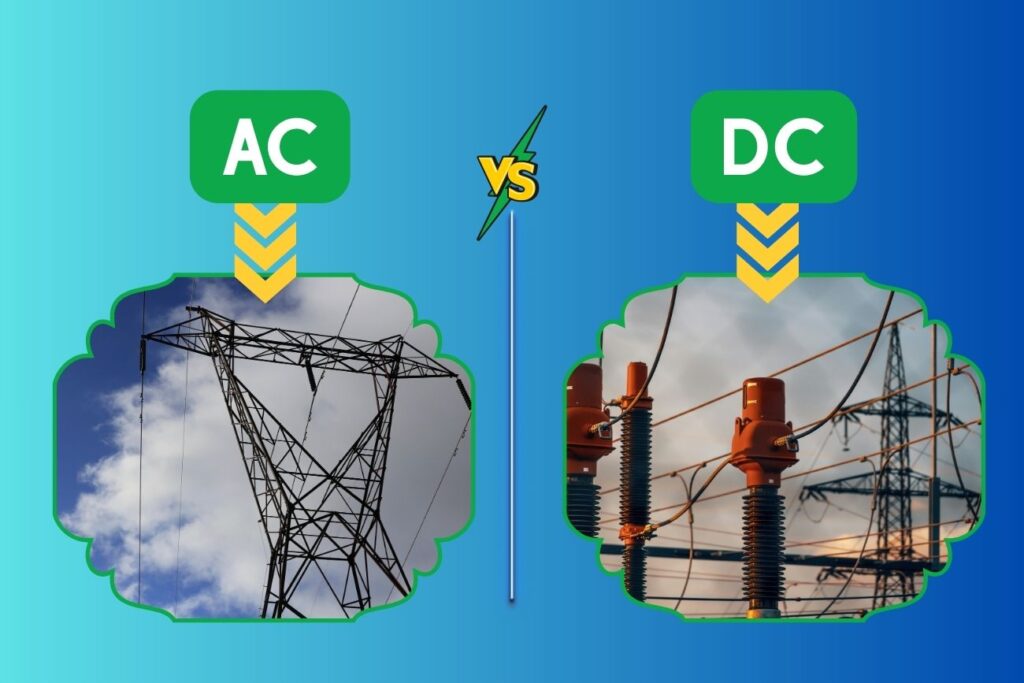
AC (Alternating Current) and DC (Direct Current) are two types of electrical current. Both are essential in powering devices, but they operate differently and are used for distinct applications.
Key Differences Between AC and DC
| Feature | AC (Alternating Current) | DC (Direct Current) |
|---|---|---|
| Flow Direction | Changes direction periodically | Flows in one constant direction |
| Voltage | Alternates between positive and negative | Remains constant |
| Source | Power plants, wall outlets | Batteries, solar cells, fuel cells |
| Applications | Home appliances, industrial machines, lighting | Electronics, computers, electric vehicles |
| Transmission | Efficient over long distances | Less efficient for long-distance transmission |
| Frequency | 50–60 Hz (depends on region) | 0 Hz (constant) |
Conclusion: AC and DC serve different purposes in electricity. While AC is ideal for transmitting power over long distances, DC is essential for electronic devices and energy storage systems.
AC (Alternating Current)
AC is an electric current that periodically reverses direction. It is commonly used in homes and businesses to power lights, appliances, and industrial equipment.
DC (Direct Current)
DC is an electric current that flows in one constant direction. It is used in batteries, electronic devices, and applications requiring stable voltage.
Key Takeaways
Both AC and DC have their unique advantages and applications. The choice between them depends on the specific requirements of the electrical system or device.
When AC is preferred:
- Long-distance power transmission
- Powering large industrial motors
- Home and office electricity distribution
- When voltage transformation is needed
When DC is preferred:
- Electronic devices and circuits
- Battery-powered systems
- Solar power systems
- Automotive applications
- When stable, constant voltage is required
Modern power systems often use both – AC for efficient transmission and distribution, and DC for electronic devices and storage. Many modern systems like HVDC (High Voltage Direct Current) are blurring the lines between these two technologies.