| Feature | Crow | Raven |
|---|---|---|
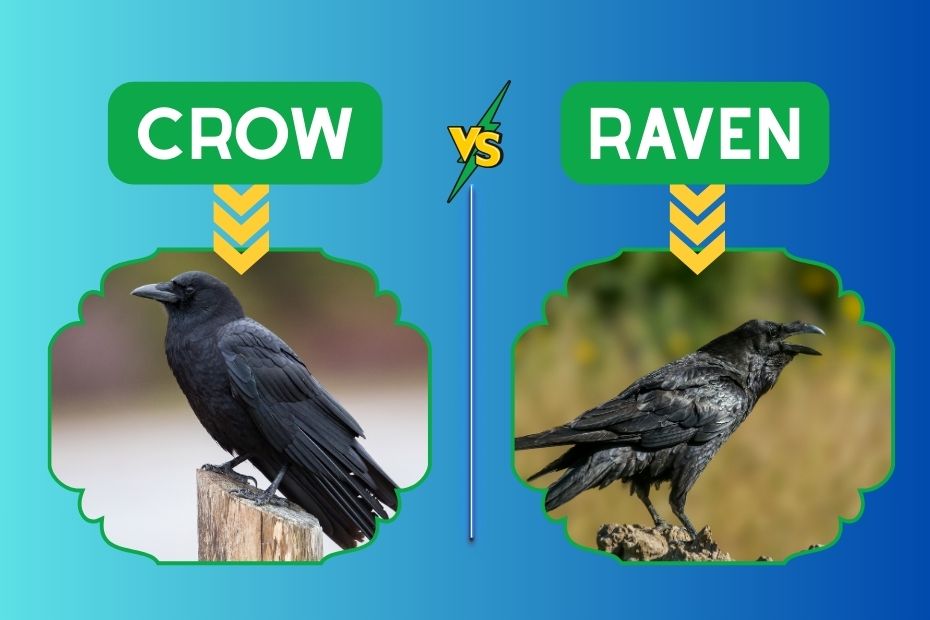
| Size | Smaller (17-21 inches) | Larger (22-27 inches) |
| Weight | 11-21 oz | 24-57 oz |
| Wingspan | 33-39 inches | 46-56 inches |
| Tail Shape | Fan-shaped, squared-off | Wedge-shaped, pointed |
| Beak | Smaller, straighter | Larger, curved with tufted feathers |
| Call/Sound | “Caw-caw” sound | Deeper croaking sound |
| Flight Pattern | Steady, direct flapping | Soaring, gliding, acrobatic |
| Social Behavior | More social, groups (murders) | Often solitary or in pairs |
| Habitat | Urban and suburban areas | Wilder, more remote areas |
| Intelligence | Highly intelligent | Extremely intelligent (problem-solving) |
Overview
While crows and ravens may look similar to the untrained eye, they are actually quite different birds. Both belong to the corvid family, which are known for their intelligence, but they have distinct characteristics that set them apart.
American Crow
Corvus brachyrhynchos
Key Differences Explained
Size and Appearance
Ravens are significantly larger than crows. A raven is about the size of a red-tailed hawk, while a crow is closer to a pigeon in size. Ravens also have larger, curved beaks with tufted feathers at the base, while crows have smaller, straighter beaks.
Tail Shape
This is one of the easiest ways to tell them apart in flight. Crows have fan-shaped, squared-off tails, while ravens have wedge-shaped tails that come to a point.
Vocalizations
Crows make the classic “caw-caw” sound, while ravens produce a deeper croaking or gurgling sound. Ravens have a wider range of vocalizations and can even mimic other sounds.
Flight Pattern
Ravens soar more often and perform aerial acrobatics, while crows typically flap steadily without much gliding. Ravens also have longer, more pointed wings compared to crows.
Behavior and Habitat
Crows are more social and often gather in large groups called “murders.” They’ve adapted well to urban environments. Ravens tend to be more solitary or stay in pairs and prefer wilder, less populated areas.
Quick Identification Tip: If you’re unsure whether you’re seeing a crow or raven, remember: “If it’s the size of a hawk, it’s probably a raven. If it’s the size of a pigeon, it’s likely a crow.”
Similarities Between Crows and Ravens
Despite their differences, crows and ravens share many similarities:
- Both are highly intelligent birds capable of problem-solving
- Both are omnivorous and have similar diets
- Both are black in color with some iridescent sheen
- Both belong to the corvid family (Corvus genus)
- Both are found throughout North America
Cultural Significance
Both crows and ravens feature prominently in mythology and folklore around the world. Ravens often appear in Native American legends as tricksters or creators, while in European folklore, they’re sometimes associated with death or misfortune. Crows also appear in many cultural traditions, often as symbols of transformation or messengers.
References
nationalgeographic.com – Raven vs Crow