When it comes to European pastries, two names stand out in almost every bakery: the Danish and the croissant. At first glance, they may seem quite similar—both are buttery, flaky, and golden brown. However, these two pastries have distinct origins, preparation methods, and flavors that set them apart. Understanding the difference between them will help you appreciate each for its unique qualities.
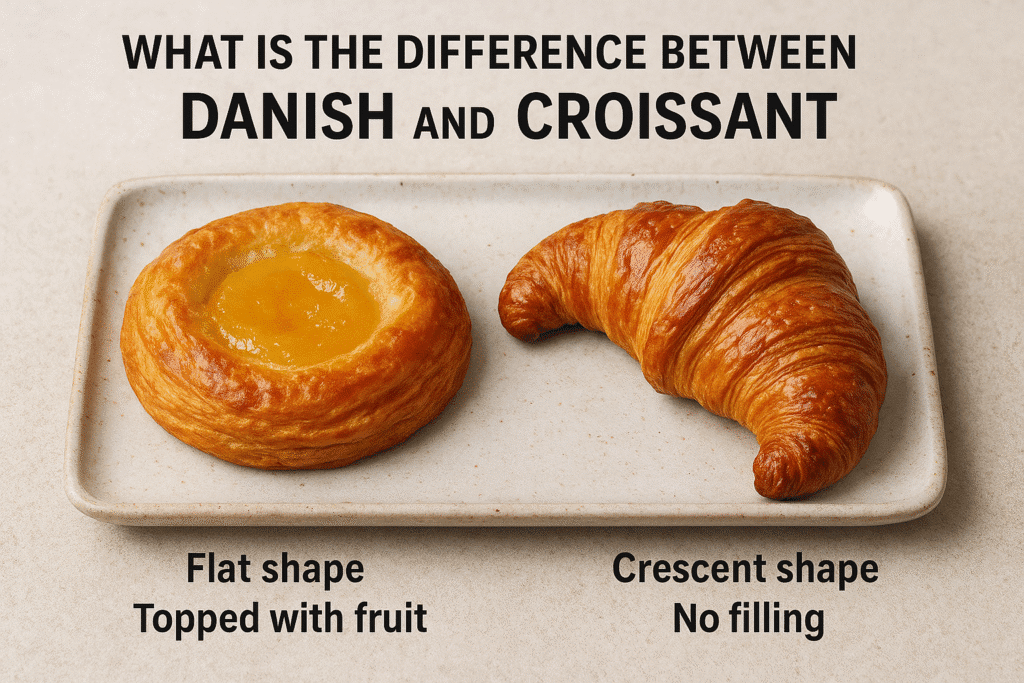
Danish vs Croissant
| Feature | Danish Pastry 🥮 | Croissant 🥐 |
|---|---|---|
| Origin | Denmark (inspired by Austrian bakers) | France |
| Dough Type | Laminated yeast dough (enriched with eggs, sugar, and butter) | Laminated yeast dough (less sweet, mostly butter and flour) |
| Texture | Rich, flaky, and slightly denser | Light, airy, and very flaky |
| Flavor | Sweeter, buttery, sometimes flavored with spices | Buttery, mild, less sweet |
| Filling | Often filled with custard, fruit, jam, cream cheese, or nuts | Usually plain, sometimes chocolate or almond paste |
| Shape | Many shapes (pinwheels, braids, twists) | Classic crescent shape |
| Serving Style | Eaten as a sweet pastry, often with toppings | Commonly eaten plain, with butter, or as part of sandwiches |
| Calories | Higher (due to fillings and sugar) | Lower (plain croissant has fewer added sugars) |
Origins and History
Croissant
The croissant is one of France’s most iconic pastries, but its roots actually trace back to Austria. Inspired by the Austrian kipferl, the croissant became popular in France in the 19th century. Over time, French bakers refined the recipe using laminated dough, which gives croissants their characteristic flaky layers. Today, the croissant is a symbol of French baking, often enjoyed plain or filled with chocolate, almond cream, or ham and cheese.
Danish
Despite the name, the Danish pastry (wienerbrød in Danish) also has Austrian roots. In the 19th century, Austrian bakers brought their techniques to Denmark, where local chefs adapted the recipe. The result was a richer, sweeter, and more indulgent pastry compared to the croissant. Danishes are often topped or filled with custard, jam, nuts, or cream cheese, making them more dessert-like.
Dough and Preparation
Croissant Dough
Croissants are made with a leaner laminated dough. The dough consists mainly of flour, yeast, sugar, milk, and a generous amount of butter. The process of folding and rolling the butter into the dough multiple times creates the signature airy texture and delicate layers.
Danish Dough
Danish dough is similar in technique but slightly richer. It usually contains eggs in addition to milk and butter, which results in a softer, more tender crumb. Because of the egg content and sweeter base, Danishes are less neutral than croissants and more suited to sweet toppings and fillings.
Shape and Appearance
Croissant: Always crescent-shaped, with a crisp outer crust that gives way to soft, layered pastry inside.
Danish: Can take on many shapes—round, braided, pinwheel, or pocket-like. The center is often filled with fruit, cream, or custard, making each one visually distinct.
Flavor and Texture
Croissant: Light, airy, and slightly buttery with a subtle sweetness. Best eaten plain or lightly paired with butter or jam.
Danish: Richer, sweeter, and more indulgent, often bursting with flavors from its toppings and fillings.
When to Choose Which?
If you want something versatile and light to pair with coffee or breakfast, a croissant is the perfect choice. But if you’re craving a sweeter, dessert-like pastry, a Danish will satisfy your sweet tooth.
Conclusion
While both pastries share a common heritage and use laminated dough, the croissant and the Danish are far from identical. The croissant is celebrated for its simplicity, flakiness, and French elegance, while the Danish is beloved for its richness, sweetness, and endless variety of fillings. Next time you’re in a bakery, you’ll know exactly what makes each pastry special—and you may find yourself tempted to enjoy both.